This one is for all the mothers out there


This week’s post features unwitting guest blogger, my mum.


Regular readers may recall that Dalrymple HQ’s mum has been experiencing some pretty exhilarating health issues over the last year or so. (See Mond und Licht for a concise summary of the early stages).

Never one to go along with the status quo, she’s kept us on our toes.

One week she’s dying, the next has defied the odds and will live forever. She survives a period of nine weeks spent shivering and cursing in hospital, only for later scans to reveal her newly regrown liver like a Christmas tree twinkling with cancerous lights. Fast forward through four months of chemotherapy and a solitary bulb burns forlornly.

The latest: the D for Dalrymple mothership has been told that, with the right treatments and a bit of luck, she can expect to remain in approximate orbit for a good while yet. There’s more surgery on Tuesday, but before that there’s roast chicken, and cake, and Mother’s Day.

She said it a lot better than me.

Honestly, this illness thing can be very confusing! One minute you’re being a brave little soldier marching down a short dead-end road, not all that hard, more like a bit incredible since you feel fine; next minute someone takes a look at your innards and tells you the problem seems almost (but not completely) to have gone, vamoosed, disappeared!

Prognosis last January, 3 months to 3 years; this Jan, more like 10 years probably! Go figure. Anyway, seems that the chemo and all the other stuff that I and my family and friends have been doing has worked.

As you can imagine, incautious tho’ it may be, we have been rejoicing up here and hope you will be too, although my father echoes over my shoulder, ‘anything for a bit of attention’…

Also, human brain, mine at least, behaving very oddly: I feel a strange sense of guilt, of letting down my nearest and dearest by not living up to their expectations (indeed, likely to exceed them, will they think me a coward by backing out? Or shall I just bore them by hanging around for ever?).  And I might have to go back on all this next week, am not that confident they can be right with such a different prognosis. Apparently very unusual. New treatment options, too, of which more anon, if you’re remotely interested.

Plus the perceptual difficulty of lengthening focus to a longer-term future…harder than you’d imagine, I’ll stick with the short, I think, makes me so much more appreciative, moment by moment…

Love you loads.

Posted in Uncategorized | Tagged , , , | 4 Comments

Read again: D for Dalrymple on How To Be A Woman

Scanning the Guardian today,  I came across this review, by Nicholas Lezard, of D for Dalrymple fave Caitlin Moran‘s How To Be A Woman.

(That’s a lot of hyperlinks for one sentence. If you clicked on all of them, you win a prize. The prize will be revealed when you’ve clicked on all of the hyperlinks.)

The review was a man’s perspective on the book. He liked it. That’s not the point. The point is, the review reminded me that friend of D for Dalrymple Neil (who is coincidentally also a man but, as far as I know, unrelated to Nicholas Lezard) a long time ago requested a transcript of my review for Carrie‘s show on NTS Live, on the basis that deaf people should have just as much access to the mind-blunting qualities of D for Dalrymple’s prose as the unfortunate hearing.

It’s with this in mind that I post below a transcript of the D for Dalrymple review of How To Be A Woman from January’s edition of Kiss My Arts. I’m afraid it’s proved impossible to provide a full transcript of the unscripted interview that followed, but if you’re unable to listen you should know that we debated the point (or lack thereof) of Lady Gaga, ‘retro chic’, Cath Kidston, cupcakes and that I sounded pretty

throughout.

If you’re hearing and you’d like to listen again, you can access the link to the recording on Soundcloud at the bottom of this post, or through the original post here. If not – see below. And if you haven’t gone out and bought yourself a copy yet – why not? Get on it.

CATlin Moran’s How To Be A Woman  [inexplicable Northern accent] was published in June last year, and since then has sold over 150,000 copies and won five awards, including the Galaxy Book of the Year. A film is in development with Film4, and there’s also a sitcom in the pipeline.

Publishers Ebury promoted the book as an updated version of Germaine Greer’s famous  text, The Female Eunuch, and the blurb on the cover references the storming of the Miss World competition, and the martyrdom of suffragette Emily Davidson. It’s clear that this is a book with an a-gen-da. But does it live up to the hype? And what kind of title is that?

How To Be A Woman. Don’t worry, boys – this book isn’t advocating any radical lifestyle changes for you, and although it’s pri-ma-ri-ly aimed at women, you shouldn’t feel excluded.

In How To Be A Woman, Moran takes readers on a whistlestop tour of episodes from her life that have shaped her identity, not only as a woman but as, quote, ‘one of the guys’ – that’s to say, a grown-up human being. We learn about her impoverished childhood and awkward adolescence, her traumatic initiation to puberty, the first stirrings of her sexuality. First love, an abusive relationship, a male dom-in-ated workplace, marriage, miscarriage, kids, abortion: each has a chapter, and along the way we’re made privy to her views on a number of other pressing issues that affect women today, from strip-clubs and the glass ceiling to the much-written-about pants issue – Moran contends that they are too small nowadays – and how women who opt for fairytale weddings are letting the side down.

CATlin Moran is by no means the only woman writing about feminism today [hgurghhhhhh], but her accessible, engaging approach and broad humour set her apart from many of the other writers publishing in this area. As she says in her introduction – tongue lodged firmly in cheek – “feminism is too important to only be discussed by academics… [realises tone has become overly earnest – switches to ‘jocular’ voice] now is really the time for it to be championed by a light-hearted broadsheet columnist.”

Moran may be a broadsheet columnist, but she’s also a prolific tweeter. Her writing is joyfully anarchic, littered with internet speak and lovingly embellished with caps for things that she feels are REALLY important. This is a book that fizzes with fun. You could say that How To Be A Woman has created an entirely new genre in non-fiction: ‘feminist humour’, as the book’s cover would have it.

As a card-carrying feminist – and as Carrie said earlier, I am actually wearing the T-shirt as we speak [as if I would be talking about any other fucking time – idiot, fuck] – I was interested to know what the feminist reception to this ‘feminist humour’ book might be. Predictably, it was mixed. Online, there are seething debates around Moran’s treatment of feminism: whether she has addressed the wrong issues, or neglected to mention the right ones. Some of the criticism was even levelled at the humour itself, and whether it’s appropriate for a subject that encompasses issues like abortion, domestic abuse, and female dis-en-fran-chise-ment. [Momentary pause for pronunciatory self-congratulation.]

After all, it’s all very well advising woman to laugh in the face of sexism and to accuse misogynists of rudeness, as Moran does – but where does that leave us when it comes to the wage gap of around 15% between men and women in the UK? How will making jokes stop sex trafficking, boost the rape conviction rate, or prevent politicians from erecting legislative barriers to women’s reproductive rights?

[Insufficient pause, incongruous change of subject] But, when it comes down to it, that’s not Moran’s mandate. And, in some ways, this book is the PR exercise that mainstream feminism so desperately needs. After all, feminists aren’t supposed to be funny. They’re earnest! About issues! Big issues! And they’re also humourless, hairy man-haters – right? Well of COURSE not. [Charity laugh from studio.] I myself am only one of those things. Moran smashes that tired preconception to bits, and in doing so opens up the feminist debate to an entirely new audience.

It’s particularly interesting reading, perhaps, for  women who might think that feminism is now irrelevant, because they, personally, are allowed to vote, go to university and work to the same pay-scales as their male colleagues.

But one of Moran’s cleverest achievements with this book has been to point out the various ways in which sexism has gone underground – has been neatly rebranded and sold back to us over the years in the form of lifestyle “choices”, such as the “options” to ironically visit strip clubs, painfully remove our body hair, and squeeze into uncomfortable, un-wearable clothing.

While the book may not dwell on statistics and research relating to the most hard-hitting social issues, it does tackle, head-on, the kind of insidious, low-level misogyny that pervades our culture. If you’ve ever opened the paper and thought ‘Wouldn’t it be nice if the Daily Mail could attack Theresa May’s policies, rather than her cleavage or her choice in footwear?’ – this could be the book for you.

Of course, I disagree with Moran on a couple of points. Take burlesque, for example. While Moran concludes, a bit like me, that strip clubs are little more than, quote, “’light entertainment’ versions of the entire history of misogyny” – burlesque shows, because they are more artistic, have better props and are attended by gay men, are somehow acceptable. I felt that not enough attention was given to the very obvious contradictions in this argument, and would have liked to have seen it “fleshed out” a little more.

The other thing I fear Moran and I will never see eye-to-eye on is Lady Gaga, of whom Moran is, famously, a megafan. I, famously, don’t see the point.  But, on the whole, I AM a CATlin Moran megafan. Just listen to this fantastic quote:

“It’s difficult to see the glass ceiling because it’s made of glass. What we need is for more birds to fly above it and shit all over it, so we can see it properly.”

How To Be A Woman saw me cry with laughter, pause for thought, and yearn for a sequel.

And what next? Well, Moran has spoken publicly about her hope that How To Be A Woman will provoke a more widespread feminist debate. She’s one of a wave of female authors who write entertainingly, with humour and energy, on subjects that touch on feminism. For a comprehensive list, you can just refer to Moran’s Twitter feed. There are legions of funny, clever, angry, cool women out there just waiting to unleash their talents on this important subject. I can’t wait.

Carrie Plitt: Hurray.

DfD: Yah.

CP: Woo hoo. I feel like clapping.

[Does not clap.]

Posted in Uncategorized | Tagged , , , , , , , , | Leave a comment

Hide And Seek, Holst and Heap

It’s been a month since my last post, but let’s put it into perspective, shall we?

Things I have not done during the last month:

  • Written blog

Things I have done over the last month:

  • Gone on two walks and three runs (only one of which was accidental*)
  • Attended four dinner parties, one pancake party and a coeliac vegan cake party
  • Participated in eleven rehearsals
  • Learned how to make three delicious new cocktails, including this neon green one
  • Composed 68 tweets for @vocechoir’s new and improved Twitter account
  • Done seven loads of laundry
  • Performed one audit of polka-dotted clothing in my possession (currently peaking at seven dresses)
  • Sung in three services (without noticeably fucking anything up)
  • Been five minutes early for work twice
  • High-fived one Grammy award-winning internationally-renowned solo artist with AMAZING hair

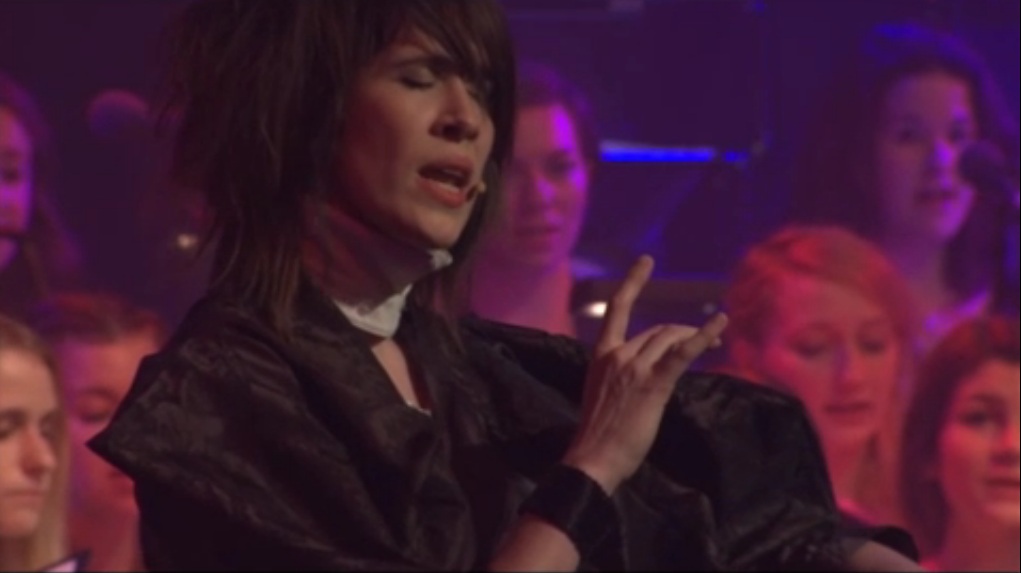
It’s that last point I want to dwell on, really. Without wanting to drop names, singing with Imogen Heap *CLANG* and the Holst Singers *CRASH* this weekend at the Roundhouse *BOOM* was, on a scale of one to excellent, very much completely excellent.

[Disclaimer: although I was singing with the Holst Singers, the views expressed here are entirely my own. This isn’t even going to be a proper review. Don’t get excited.]

The concert on Sunday 26 February was part of the Reverb festival, ten days’ worth of stellar contemporary classical music programming staged in the Roundhouse’s Main Space. You can currently catch a number of these concerts (and the second half of this particular one) online at the Guardian website. The first half (in which I wasn’t involved and therefore will not dwell on, because I am selfish like that) showcased the talents of rising star Ana Silvera. She was accompanied in a self-composed song cycle by the effervescently brilliant Estonian TV Girls’ Choir, who are, frankly, way too good to have a website that shit.

I’m afraid that I spent most of this half trying to source dinner, so can in no way be regarded as a reliable critic. However, my mum, who initially fumed over ‘having to sit through a whole bloody 90 minutes that you’re not even IN’ said that she loved Silvera’s set and was so thoroughly engaged that she had no concept of the time passing at all.

The second half kicked off with a screening and live performance of Imogen Heap’s soundtrack to the 1928 Surrealist film La Coquille Et Le Clergyman (The Seashell and the Clergyman). Imogen has has performed this twice with the Holst Singers before: once at the Birds Eye View film festival in 2011, and again for Latitude last year. I was lucky enough to join the choir just in time for this, the work’s third major outing.

Over the years I’ve sung quite a lot of stuff that I would mentally file under ‘weird, difficult modern shit’, but this piece was still one of the oddest pieces of new music I’ve ever performed. It was also one of the most enjoyable: three days later, I’m still humming bits and pieces. I expect we all are. It’s not just the singable, scat-like parts – it’s the humorous, playful touches, like soprano Polly’s amorous squeakings (around the 18 minute mark if you’re watching on the Guardian website) – the heartbeat chest thumps – or the mournful whale-like noises that punctuate the clergyman’s fevered imaginings. They stick in the mind.

As Imogen explained during rehearsal, she’d aimed to keep the music unrepetitive and unthematic to match the film’s surrealist aspirations, yet engaging enough to keep a modern audience interested. The result is a meeting of primitive vocalisations, bizarre vocal effects and enthusiastic body percussion with catchy, poppy tunes, lush harmonies, and  almost Klezmer-like melodies. Singing it was a mental challenge, a vocal work-out and an advanced assault course in score-reading.

It was also, let’s face it, a little bit rock ‘n’ roll. Standing mics enabled the choir’s sound to fill the arena. Overhead screens carried footage of the performance captured by roving cameras. There were also exciting lights, bright colours, and soft fabrics, and a click track** to keep everyone in sync with conductor Hugh Brunt and the film itself.

It was a bit of a culture shock. Most of the concerts I do tend to be in churches or concert halls where the choir / orchestra is at one end, and the audience, facing them, at the other. The settings are almost universally quadrilateral. The Roundhouse is different. The clue is in the name: when we arrived for rehearsal, a note on the door of the ladies’ changing room advised the men of the choir to ‘find a quiet corner to change in’. As one smartarse tenor noted in a scrawled addendum: “It’s a Roundhouse. There ARE no corners.”

A former railway shed that was designed to allow whole engines to be rotated inside, the Roundhouse has been a cultural and performance centre since the 1960s. Although the performance space isn’t entirely in the round, performers on the stage of the Main Space are surrounded by an audience that stretches to the very edges of their peripheral vision. In this instance, hundreds of audience members were seated around cabaret tables at ground level. One level up, there were banks of seats and a bar with squashy sofas and armchairs. Around the top there was room for standing ticket holders.

But it wasn’t just the venue – it was the atmosphere of the event. When the film finished, a man came on stage and asked the audience to ‘give it up for Imogen Heap and the Holst Singers’. That just wouldn’t happen at most concerts I do. I’m not saying those concerts are bad –  they’re just different. And I can see how, if you weren’t ‘into’ classical music, it would be more intuitive for you to attend a gig like this rather than diving in at the deep end of cultchah. I go to hundreds of classical concerts, and I still think I’d find it easier to relax sat around a table in comfortable darkness with a drink than wedged in a cold, hard pew in a building where you can see your breath in June.

The film was followed by a second, blindingly good set from the Estonian TV Girls’ Choir. It was so perfect that, by the end of their fourth Tormis song,  my face hurt from grinning. And then it was time for the choirs and soloists to join together for a final performance of their most well-known songs: Letter From New York from Ana Silvera, and Hide And Seek by Imogen.

A couple of people I told about this project were just a little bit snobby about it. And to them I say: screw you. Because Hide And Seek, friends, is a peach of a song. It has a gentle melancholy and wistfulness that, despite the fact I hardly ever listen to the words, taps into a very tender part of me. Here’s my favourite part from the SATB arrangement by René Gagnon that we performed (at around 1h 3m on the video):

Mm, what you say? Mm, that you only meant well? Well, of course you did.
Mm, what you say? Mm, that it’s all for the best? Of course it is.
Mm what you say? Oh, it’s just what we need? (Tenors, with feeling) YOU decided this.
Oh, what you say? Oh, what did SHE say?

This is, in short, the kind of song that makes you yearn for a messy break-up – just so you could sing it through the tears and the snot. And when you’re part of a performance featuring the composer and 50 trained voices in a venue like the Roundhouse in front of an audience who know and love the song and who drench you with a tidal wave of applause barely seconds after the final notes have died away… well. That’s a pretty special feeling.

The video of the second half is available on the Guardian website until midday on Wednesday 7 March. It’s worth a watch – not only does it highlight the purposeful surreality of Imogen’s score for Seashell (something I couldn’t fully see until I’d watched the footage back, despite having been involved) but there’s boobs. Yes, boobs. I didn’t even know they HAD boobs before 1930. I’m not sure if that part of the film is shown in the Guardian coverage. You’ll have to watch it to find out. It shouldn’t be too much of a trial.

Watch Imogen Heap and the Holst Singers online at the Guardian website.

All stills are from the video on the Guardian website, 29 February 2012

* Accidental AND ironic. Through a blizzard and six inches of snow to catch the last train after singing in RWV’s Sinfonia Antartica, thereby inadvertently gaining a whole new insight into the hardships of polar expeditions

** In future, when anyone mentions ‘the click’***, I will be able to nod carelessly and make small talk about earpieces. FUCK yeah.
*** If you don’t know what ‘the click’ is, I’m afraid that you’re not cool enough for me to explain.

EDITED at 08.48 on Thursday 1 March for grammar, bullshit and lols.

Posted in Uncategorized | Tagged , , , , , , , , , , , , | 5 Comments